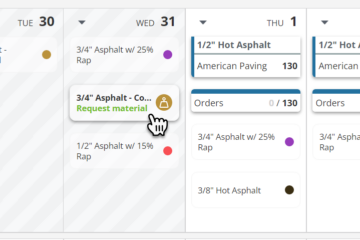
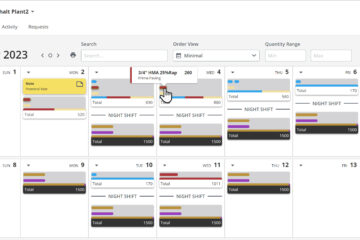
PlantDemand has published a new ungated white paper, AI Agents in Asphalt Plant Operations: A Practical Framework. Read it online or download the PDF. No email gate, no form to fill out — just a practical framework for producers.
Why we wrote this paper
Plant managers in the asphalt and aggregate industry are being asked, more often every month, what their AI strategy is. Boards want to know. Owners want to know. Younger team members coming in from other industries want to know. Most of the publicly available material on AI in industrial operations treats artificial intelligence as either an inevitable transformation that will reshape every plant by next quarter, or as pure hype that can be safely ignored. Neither framing actually helps an operations leader decide what to do this quarter.
So we wrote a paper that does. AI Agents in Asphalt Plant Operations: A Practical Framework is a practical framework for producers, written for the people who actually run plants — not for venture investors or AI researchers. It is published ungated, on purpose. The audience for this paper is busy, and we want it read, not collected.
The paper draws on what we are seeing in the field as PlantDemand customers connect AI clients to our production Model Context Protocol (MCP) server, on publicly available industry research [references in the full paper], and on more than a decade of experience building software specifically for asphalt and aggregate plant scheduling.
What is in the paper
The paper is organized into six numbered sections plus a references appendix:
- The current state of AI in industrial operations — what is genuinely new about generative AI and AI agents, and why this wave is different from the predictive-maintenance and computer-vision deployments many plants already run.
- What AI can and cannot do for plant scheduling today — an honest, defensible accounting of where AI agents add value in plant scheduling right now, and where they do not. This is the section we expect operations leaders to share with skeptical colleagues.
- A practical framework for adoption — four sequential phases, starting with structured data and ending at decision support. The order matters; skipping ahead is the most common reason AI projects in industrial settings stall.
- The Model Context Protocol (MCP) standard — what it is, why it has become the de-facto industry protocol for AI agent integrations, and why that matters for any producer evaluating an AI-enabled vendor in 2026.
- PlantDemand’s MCP implementation as a working example — exactly what the production server exposes, how it enforces the same permission model as the main application, and which AI clients can connect today.
- Recommended next steps — organized by where you are today, including a short checklist of vendor questions worth asking.
Who the paper is for
The paper is written for plant managers, operations leaders, dispatch and scheduling supervisors, and IT decision-makers in the asphalt and aggregate industry. It also serves as a vendor-evaluation reference. If you are sitting through a sales pitch from any software vendor that mentions AI, the final section gives you a short list of substantive questions to ask.
Producers who are already digital — running scheduling, orders, materials, and customer data in a structured system — will get the most immediate value from the paper, because they can act on the framework this season. Producers still on whiteboards and spreadsheets will find the paper useful as well, because it makes the case for why the structured-data foundation is the prerequisite for everything else.
The headline argument
AI agents are most useful in industrial operations where structured operational data already exists, and where the agent is given carefully scoped, read-only access through the same permission model the business already trusts. The Model Context Protocol (MCP) is the cleanest way to provide that access today, because it is an open standard supported by every major AI client vendor — meaning a producer is not locked into any single AI client choice.
PlantDemand operates a production MCP server at https://plantdemand.com/mcp that producers can connect AI clients to right now. The server is an adapter on top of the existing PlantDemand backend; it does not introduce a parallel API with separate logic, separate permissions, or a separate place for things to break. Every request is authenticated, every response respects the same plant-level permissions, and every tool is read-only by design.
For producers still running scheduling on whiteboards and spreadsheets, the prerequisite work is moving to a structured system. AI is downstream of that decision, not a substitute for it.
What is deliberately NOT in the paper
Several topics are conspicuously absent from this white paper. We left them out on purpose, and the paper is more useful because of it. There are no fabricated customer quotes or invented metrics — placeholder slots are clearly marked where a real, named customer outcome would strengthen a future revision. There is no claim that autonomous AI scheduling is a 2026 use case for asphalt plant operations, because it is not. And there is no vendor-versus-vendor comparison; the paper focuses on the framework, and the question of which AI client a producer should pick is treated as downstream of the framework, not upstream of it.
Read it
Visit the white paper landing page for the summary, table of contents, and download links. You can read the full paper online in your browser, with a clickable table of contents and inline references, or download the PDF version for offline reading and circulation inside your organization. The PDF is fully ungated — share it freely with colleagues, customers, or anyone who would benefit from the framework.
For producers ready to connect a client today, the PlantDemand MCP documentation hub has step-by-step setup guides for eight AI clients, including Claude Desktop, Claude Code, Cursor, Replit Agent, Microsoft Copilot Studio, Azure AI Foundry, Kiro, and ChatGPT. If your team would benefit from a walkthrough of how the MCP server fits into your existing PlantDemand workflow, our team is available — get in touch and we will set up a working session.